Excitement in the cellar after the harvest: when everything comes together in the winery
Excitement in the Cellar After the Harvest: When Everything Comes Together in the Winery
When manual harvesting comes to an end at Domaine les Teyssonnières, peace does not immediately return to the foot of the Dentelles de Montmirail. While the rows of vines regain their calm under the autumn light, a whole new story begins behind closed doors in the winery.
Contrary to popular belief, the end of the harvest does not mean the end of the winemaker’s work. It is in the cellar that the raw grape material is sublimated to give birth to all our cuvées. Between fermentations, punching down (pigeage), and the delicate devatting stage, dive into the heart of this vibrant period when our future vintages are crafted.
.
Fermentation: Grape Must Becomes Wine
As soon as picking and sorting are complete, the grapes enter the winery to be filled into tanks under strict temperature control. This is where alcoholic fermentation begins.
For several weeks, the cellar echoes with lively bubbling and fills with characteristic aromas of ripe fruit and spices. The sugar in the berries is gradually converted through the action of natural yeasts:
Cap formation: Pushed by carbon dioxide, the richly pigmented skins of Grenache, Syrah, or Mourvèdre rise to form a solid crust on the surface of the juice.
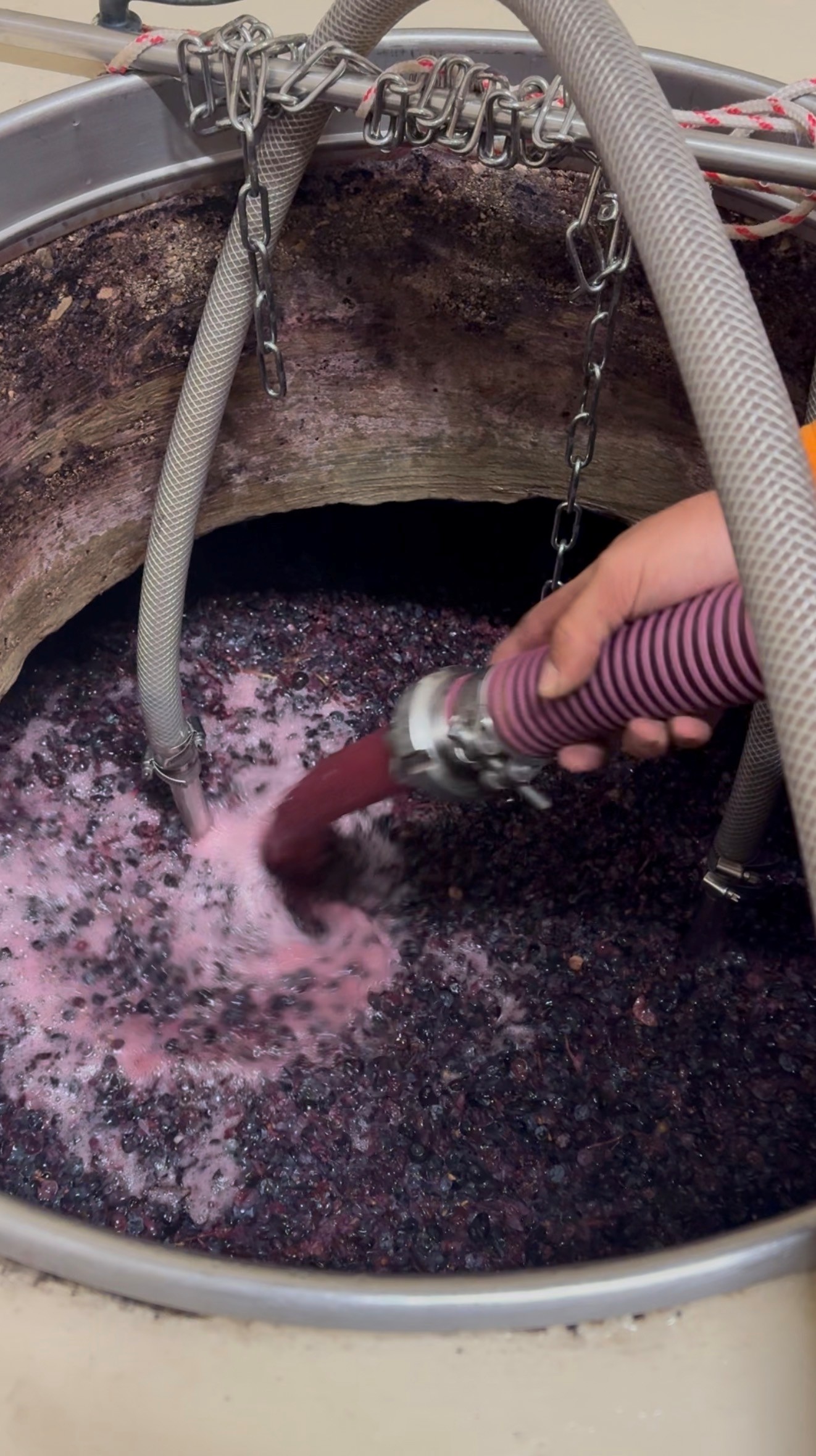
Extraction work (pumping over and punching down): To extract the deep color, rich aromas, and tannic structure that characterize our wines, the juice from the bottom of the tank is regularly pumped back over the cap.
Devatting: The Key Stage After Maceration
After the maceration period, the long-awaited moment arrives: devatting (décuvage). This is the decisive instant when the winemaker separates the free-run wine from the solid materials.
How does devatting take place at the domain?
Free-run juice flow: First, the tank valve is opened. The clear juice — the free-run wine (vin de goutte) — flows out naturally by gravity. It is a smooth, pure wine endowed with great aromatic finesse.
Raking out the pomace: Winemakers enter the tank to manually clear out the pomace (skins and seeds) left at the bottom. It is a demanding physical task requiring precision and technical skill.
Pressing and press wine: This pomace is transferred to the press. The extracted juice, darker and more structured, is the press wine (vin de presse).
Depending on the profile sought for each cuvée and terroir expression, the winemaker may blend a precise proportion of press wine into the free-run wine to add structure, ageing potential, and complexity.
Malolactic Fermentation and Ageing
Once devatting is complete, the wine’s evolution is far from over. It begins its malolactic fermentation, essential for the stability and roundness of red wines. This step converts malic acid into lactic acid, softening the overall acidity.
Next comes the period of rest and ageing (élevage). For several months, depending on the appellation and cuvée, the wine will refine in tanks or large wooden oak vats (foudres), developing the distinctive character of our estate and the rich terroir of the Vaucluse region.
Come and Discover Our Wines at Domaine les Teyssonnières
Autumn is an ideal season to explore the vineyards at the foot of the Dentelles de Montmirail. The flamboyant colors of the landscape offer a striking spectacle, while the wineries still carry the fragrant mark of the recent devattings.
Located in the village of Gigondas, Domaine les Teyssonnières welcomes you to its tasting cellar to share its passion and let you sample its range of wines.
En poursuivant votre navigation sur notre site vous acceptez l'utilisation des cookies ou technologies similaires pour disposer des services adaptés ainsi que pour la sécurisation des transactions. En savoir plus.